Showing posts with label ideas. Show all posts

Monday, 22 December 2014

Pecha Kucha and other research

This week we presented ideas we've been researching related to sketch innovation so far, to share our thoughts as a group. Pete briefed us to present in a 'Pecha-Kucha' inspired style. I like the fact that this (mostly!) kept things quite concise and to the point, with little snippets of information and inspiration being raised through each person's series of images and corresponding explanations. I hadn't heard of this form of presentation before, so there we go- I've been learning new things all the time on this module! From the definition of a pamphlet book, through to what a Pecha Kucha presentation is- fantastic :)

Here is a view of the images I presented:

the first section was drawings/sketches that have been significant in my own work-

brio play, pencil and ink (2013), and digital prints (own images)
The drawing on the left was made during my first year- it was a progressive drawing from a selection of objects I had infront of me. I began by drawing the brio train track piece in pencil, and then told myself I'd use a different media to add in each extra element, to build up a collage style drawing that could give inspiration for a print design. The 2 digital prints next to this image, are the outcomes that followed- my playful initial sketch, led me to playful, collage effect patterns, that used re-drawn, scanned in versions of the 'brio' motif as a start point. I had no idea at the time, that my initial quick sketch would shape my outcomes for that technical block unit. It just shows- the influence of one drawing can go far!

acrylic paint over oil pastel base, scratched into (2014), and fabric samples incorporating trapping, laser cutting, embossing, foiling and heat pressing. (own images)
The left shows a drawing made exploring the idea of braille (writing for those who are blind) in colour, playing around with braille cell coding that reads 'touch me', to create pattern. Following this, I began sampling fabrics that would have sensory qualities, with sections of braille and raised surfaces embossed into them, to create coded patterns. Braille is such a beautiful language, and I wanted to explore the idea of tactility, and surfaces that would invite touch. But also, from my original drawing, I was thinking about how braille is colourless- so I added colour and shine and different textures into my work, to increase the sensory appeal, regardless of whether people are sighted or not.

pro marker sketch of postal stamp (2012) that lead to photoshop print (own images)
When I was looking back at my foundation work, I was interested to see that even then, I was instinctively selecting sketches from my early design development, and carrying them through to print design work. I realised that I enjoy working in this progressive way- combining hand drawings with digital technologies, by scanning things in and manipulating/layering them up in photoshop
paperbead collage from current project, using paint, paper, pencil and wax resist (2014)
This is from my most recent project, which I have been working on alongside this module. And infact, the emphasis on exploring sketch in this module made this drawing very significant indeed. Because as I was creating this collage, based on my research of paper beads made in Tanzanian culture (Tanzania was my research focus), it lead me to explore the shapes of the beads, and create my own jewellery designs as an outcome (one of my pieces in development is pictured in the centre of this image)

Drawings that have influenced me: 

Lina Peterson jewellery design sketch, images available here
Lina Peterson's approach to jewellery design really inspired me on my current textiles practice where I was creating my own jewellery collection, since I was also working with wood and plastics in a contemporary way. I found it really useful seeing her little development sketches, as it helped me think about the construction of my own pieces, and how ideas can translate from 2d to 3d in terms of textiles for accessory.
Mia Christopher, colour tests, more sketchbook pages can be seen here
 Our current project in textiles has been focused on colour, and I like how Mia Christopher uses her sketchbook pages as a place to play with and explore colour. While I was putting together my colour palettes for this project, and producing different colour combinations, I created a fair few pages in my own book that looked a little like this!
Eric Carle, 'The Very Hungry Caterpillar', collage style- illustration
 I included this image in my presentation, as 'the very hungry caterpillar' was one of my favourite childhood books, and I was always fascinated by the bright colours and textural qualities of the illustrations, created by Carle's painted collage style.

Innovative practice:
Daniel Etock, pro markers bleeding onto white paper (2011), see more here
When I was looking at playful methods of drawing last year to inspire my 'things to play with' project in Textiles, I researched into Daniel Etock's work, and it came back to mind when I was thinking about this presentation. I love that the final piece is organic- there is no guarantee exactly how the pens will bleed into the paper, so the resulting pattern is not calculated or controlled- it involves an element of surprise! I also like how Etock left the pens for differing amounts of time to see how this would effect the marks that are made. It would be interesting to take this idea into fabric, and perhaps the dyeing process- applying a technique to samples of fabric, but each time carrying out the process for a slightly longer amount of time, and seeing what is left on the surface in terms of texture and pattern with each sample. Even repeating this pen experiment onto fabric could be interesting, as different fibres might soak up the ink to different intensities and it might spread in different ways across the fibres...so much potential for future experimentation!

BA Textiles collaborative drawing of the Queen (2013), pencil onto pieces of A1 cartridge paper (own photo) 
I really enjoyed this collaborative drawing we did together as about a group of 40 people in our textiles practise. We each were given a 1cm square section of a picture- none of us knew what the picture itself was, we just knew that each section was numbered, so when we'd all drawn our small piece out onto an A1 sheet, we could match them together to reveal the final image. This was a good experiment in terms of scale, as drawing out a 1cm square section onto an A1 sheet required some thinking and planning! And it also required trust- that somehow our section would work together in the picture as a whole, and fit in to what everyone else was drawing. (My piece is the lower part of the crown just above the left-hand eye, as the picture is facing us). I think large-scale collaborations with lots of people are a good way to innovate- as everyone's individual contributions mix together to produce a piece that contains within itself, many different stories and styles, meaning the outcome is both collective and individual at once. It would be interesting to try this task with lots of different groups of people, and then have a display of many different individual yet collaborative pieces.

Judith Ann Braun, 'fingerpainted' charcoal drawings (see more here)

I really like how Braun creates environments out of her work- often covering gallery walls or exhibition spaces, it's like a fingerpainted backdrop or scenery. Her work is very expressive, and in contrast to our task of making a 'drawing device', where marks were made autonomously by an object or process (as also with Eatock's pen pictures), Braun's work is all about the body and movement- marks go as far as her arms can stretch, and boundaries are set by the shape of her fingers. She works a lot around pattern and symmetry, using both hands at once to create a mirrored effect.


So, that's my little presentation write up! When we shared our findings in the group, it was interesting to see the mix of things that we classed as 'innovative', incorporating both hand and machine created outcomes. It would be interesting to cross these two areas, perhaps. I liked the video Pete showed us of a large scale 3D printing machine, that is able to print 'paths' of line into empty space from the floor or wall (reference video here). Printed drawn 'paths' like this, could then be hand-drawn ontop of by people, to decorate the surface of the 3D line- a way of 'drawing' onto a 3D drawing, and combining machine and human sketching into the same piece...

In this video I found, 3D printing has been used to seamlessly slot into the real world- in this example, it is a continuation of a wall, to make it look as though it has been constructed from Lego bricks. I like the idea of being able to use 3D printing as a way of 'drawing' into reality, to play with appearance, context and meaning, by adding to everyday sights with bits of printing, that at a glance, appear to be real. On a recent trip to the science museum, I saw many other 3D printed objects, and I think it opens up fascinating possibilities to extend the idea of 'sketching', quite literally, off the page. 

Through technology, 'sketches' can actually become three-dimensional sculptural forms, in real time.

In terms of Textiles, this also reminds me of something I blogged about last year- Fabrican spray on fabric (see my original post here!).
spray on fabric t-shirt (image accessed here)
I think this is a type of drawing, too- the ability to 'draw' your own clothes directly onto the body. Also, in turn, this process creates a kind of drawing/record of your own unique body shape, as the sprayed-fabric can be taken off, hung up, or re-worn after it has been made, and it retains it's original sprayed form. 

Although technology is arguably taking us increasingly away from paper as a society, it does not mean that these new possibilities are the end of 'drawing'...infact, perhaps all these things merely are a form of sketch innovation, where technology is becoming the drawing implement of choice!

project- feed in!


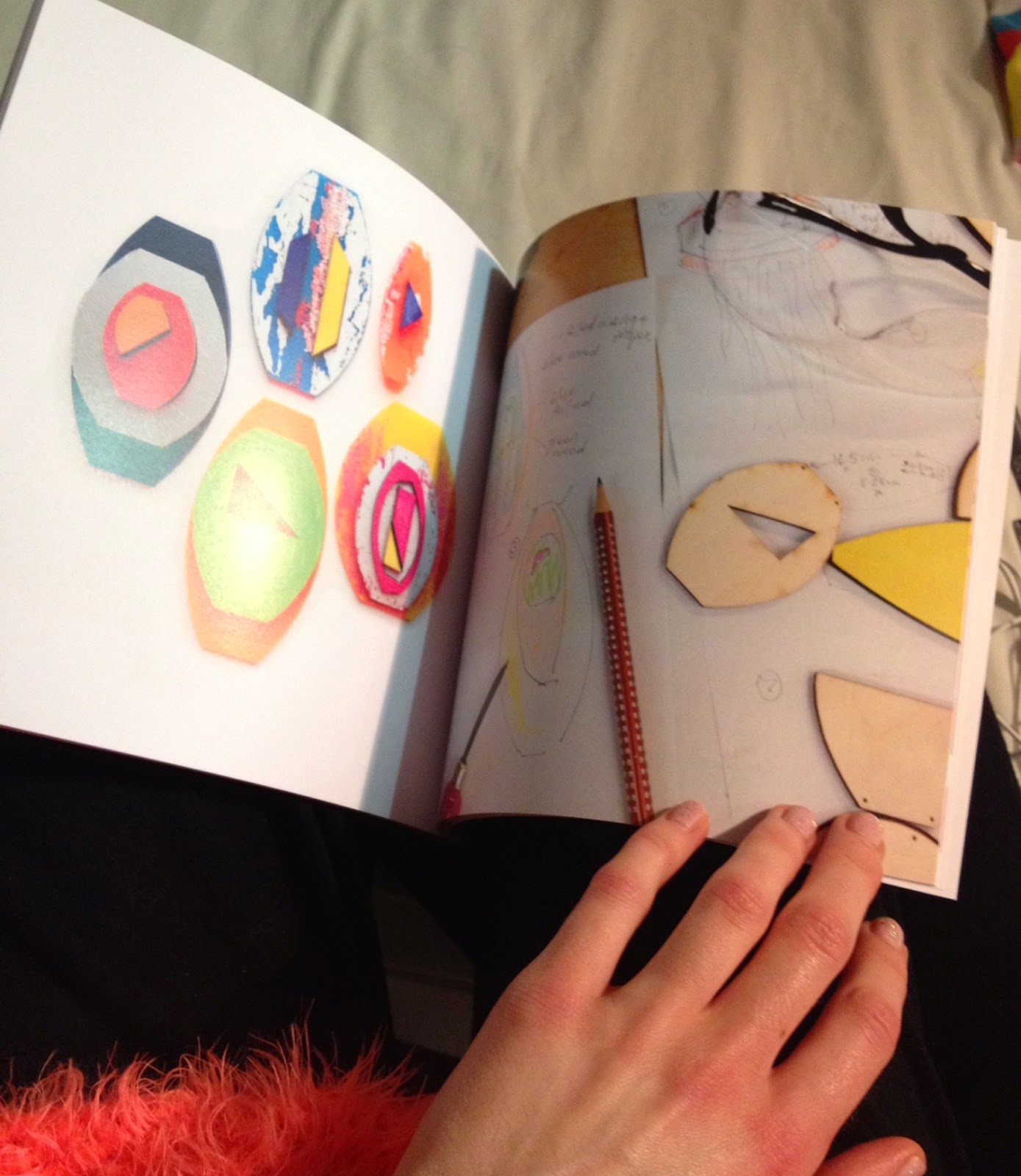
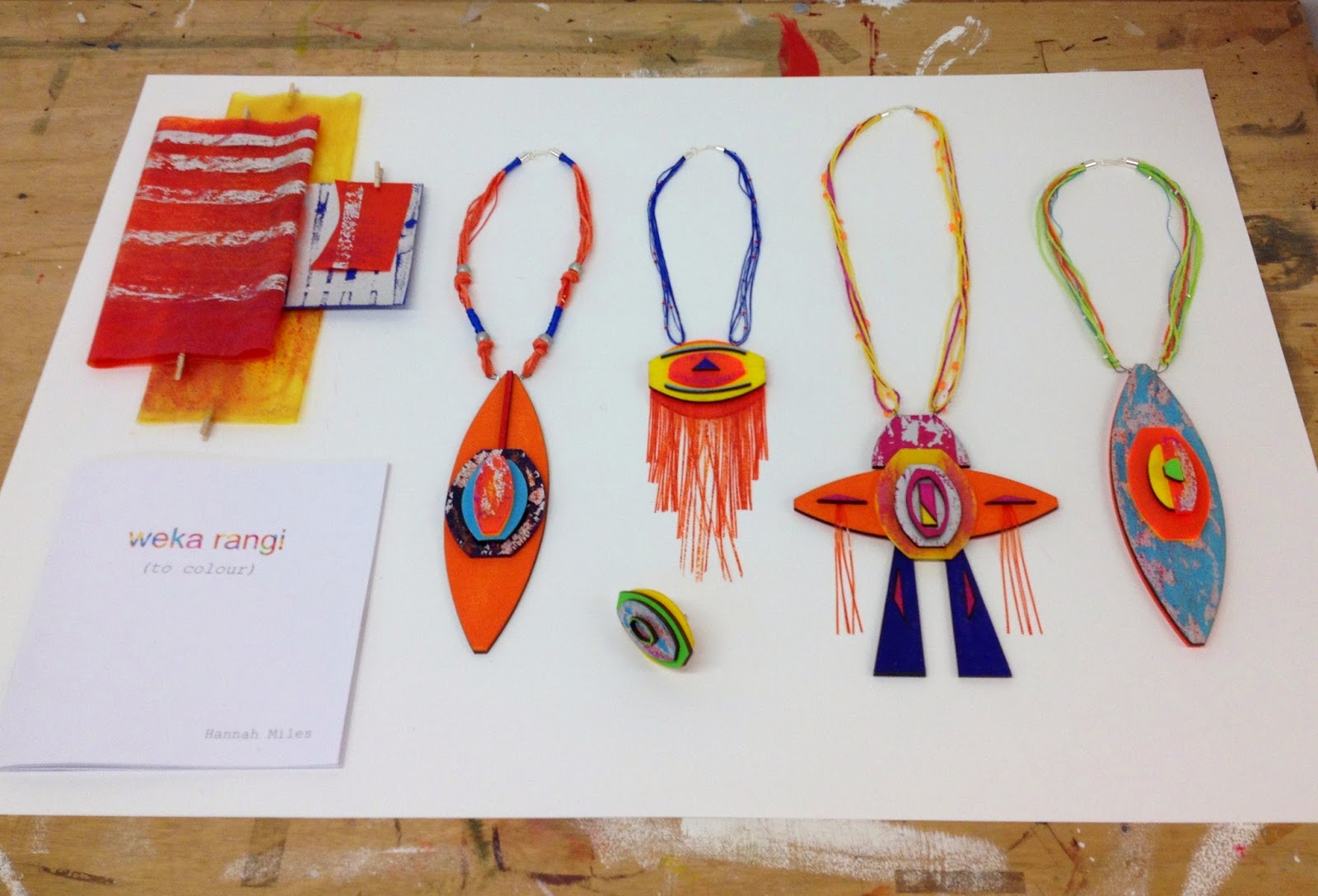
Since this unit is focused on sketch, I've been considering the importance of my design-development drawings more in my textiles practise. As part of our assessment this term, I produced a look book telling the story of my jewellery pieces (which were my final outcome for the project). Initially I just included my colour palettes and research photos in the look book, to show influence of where my ideas had stemmed from. However, while I was putting the file together on indesign, I was thinking about our sketch sessions, and how drawing is actually a very key part of the design journey- it helps communicate how I worked out how to assemble and construct my pieces...so, I scanned in some of my sketches relating to my project development, and in-dispersed them through certain parts of my lookbook.  When we had our exhibition, lots of people commented to me that the look book worked really well, and that seeing the 'behind-the-scenes' parts of my project, such as the sketches and photos of the making process, really added to people's understanding and appreciation of my final pieces.

I wouldn't have thought to have given prevalence to my sketches and design process in my look book if it hadn't been for the influence of this module- so thank you Sketch Innovation Fridays! 

My jewellery pieces, selected samples and look book in the BA Textiles 'colour exhibition'

view of inside look book- with photo of sketches/development making included on right hand page

Friday, 28 November 2014

drawing machine research

So the task for our next session is to make a 'drawing machine/device'! It's got to be something that produces a drawing aside from the conventional method of putting pen to paper by hand.

It seems that we, the students of this sketch innovation module, are not the only ones attempting to create devices that create drawings for us. I found this drawing machine on Dezeen magazine's website, which is a simple wind up toy produced by the company, 'All Lovely Stuff' (see http://www.dezeen.com/2012/12/22/drawing-machine-wind-up-toy-by-all-lovely-stuff//). It uses easy to find objects- a clothes peg, cotton reel, felt tip, and rubber band- which are assembled together and then make drawings when the cotton reel is wound up, and let go.

As I continued my research, I got very excited by stumbling across the work of Echo Yang.
You can find her website here. (it's worth a look!)
Yang is fascinated with digital technologies that now allow designers to be driven by computer processes to produce outcomes that aren't completely planned or expected. Rather than having in mind exactly how the end design will look, many users of digital technologies play around with machines, algorithms and software to generate automated responses. However, Yang wanted to apply this 'automated' approach to old analogue technologies. She undertook a series of experiments with various analogue objects that are now considered as 'old technology', using them as implements to draw with. Rather than creating her own algorithms with state of the art technologies, her work exposes and depicts the inner rhythms, functions and workings of old technologies.
Alarm clock and pen drawing 

Handmixer filled with watercolour 

nodding bird drawing (with the help of a cotton bud and paint)

Hoover and ink drawing
I really like how Yang has almost hijacked objects to expose how they work, by using them to create drawings of the functions that they normally would perform. The results are really beautiful, and I think they serve as a great reminder of the wonder of all the objects and world that we take for granted and overlook around us....when really, even the most mundane, day to day objects can produce fabulous things, if we can only see them differently!

I am feeling very inspired. I like this idea of 'drawing' processes that usually go unnoticed, or unrecorded. It would be interesting to experiment with this within my practice in Textiles, perhaps creating some way to record my sewing/ironing/creative process as it happens....

For next session, I already have an idea for my drawing device that I'll present- but this is definitely an area with plenty of potential to explore and delve deeper into!

Thursday, 6 November 2014

All booked up - Part 2

So, in the first part of this post, I was reflecting on my own working style and sketchbook practise.
But now- onto what I saw and learned from others and THEIR books!

It felt like each person's book reflected their thinking processes- which figures, as in the first week we discussed about how a 'sketch' is a visual record of a thought/event/idea...so a sketchbook is basically just a whole flow of these recorded ideas! I loved seeing how some people worked in a very structured, ridged way, while others whacked anything and everything into their books, using them almost like a journal of their day.

After talking about my own work, I then had the pleasure of seeing Abi's.
Her book felt very personal, with lists and notes to herself scribbled on pages every so often. I particularly liked that this one was upside-down!
Then moving on to her project work, she seemed very comfortable developing ideas in her book, allowing collaged images and scribbles of colour to speak for themselves as visual triggers for other research, which she said is outside of her book on loose sheets.
 Her sampling definitely felt like it was being recorded for herself- with little annotations to act as a reminder of what she did/how many needles to use/specifics about techniques of the knitting. 
 There was definitely a sequential feel, as she then remade and developed certain samples, and then used drawing and photocopy collage to demonstrate how they could work as a full garment. The development of her ideas felt quite natural and organic- it seemed she recorded things in the moment, and it helped each new development to flow together well. 

 Next I looked at Lisa's book! I loved the energy to her work- things were clipped in, with little sketches added ontop in layers at places, which added to the sense of her ideas all tumbling out.
 There was really a feel of 'personal language' in her sketchbook journey- she seems to enjoy doodling and writing words that capture her emotion to express how she feels her work is going, alongside the actual work itself (as evidenced below in pink and orange highlighter!)
 Her style has quite a rapid feel to it, with research and experimentation taped in over various pages. I thought that this aligned quite nicely to the outcome of the particular project this book was documenting- she made some big wooden monsters to inhabit a land of her imagination- the bold, patched together presentation of her work mirrored this.

 In terms of a sketchbook being a 'place to play', I found this quite true of Lisa's work. 
On these pages, she drew Koalas...because, in her words, 'why not?!'
I think this is quite a delightful little interlude in the middle of her work. And why shouldn't sketchbooks have seemingly random parts to them- because it's often the random little things in day to day life that spark off inspiration for ideas, so it's great to see this so openly embraced within the sketchbook itself. (Although Lisa wasn't so sure when it actually came to letting us take a photo of them. But I love it!)
 It was wonderful seeing work from other disciplines, too. As a textiles student, I don't think I've ever really had a proper insight into the way graphics and ISD students work.

Here's 2 images from Nisha's book, who is studying interior spatial design. She said her book was mainly a way to think about process for her larger separate sheets of work. Her drawings were linear, and weren't worked into in any particular way, she tended to focus more on using her book as a notebook to write in.

 I asked her about the colour-coding of her notes, as there seemed to be some kind of system. She said she used the colours to show different levels of importance, and to categorise her thinking. Personally, I found this is quite a good idea. Although in textiles, it would probably be a good idea to select colours that won't interfere with the colour palette of the sample work itself!

Then I saw Sayaka's book from graphics. Thinking about sketchbooks being a tool to 'make sense' of things, I really got that feel from Sayaka's work, as when she showed it to us she said things like 'I don't know why I drew this at the time', or 'I was travelling and just felt like doodling this', and 'I started drawing this, and then it turned into this'...
 She was also a list writer!
 In relation to her area of study of graphics, you could sense that even the little doodles were all starting points for a graphic design that could be developed further. 

I was really fascinated by Winne's book from ISD, probably because she largely works in such a different way to myself! Rather than being bursting with samples and fabrics, Winnie's work had a calmness to it- things were measured and calculated, and had an air of precision. Obviously precision is important in textiles too, but even her experimentation felt architectural and structural- as this is the context that she is working to all the time. She seemed to be drawing to develop her understanding of space, which I suppose when you are designing for spaces, is quite a vital thing! I liked the way she drew in human figures also at points, as if the drawings are a way to imagine things to a full-size scale.

 In a separate book, Winnie also sketched simply to 'practise drawing', and I thought this was lovely. It let her personality shine through in a more individual way than her more technical book, and allowed her to develop ideas simply for fun, that could then feed into projects when relevant. It seems that whatever your field of art is, it's good to have a non-specific book simply for the purpose of play and enjoyment- for discovery, that could come in handy sometime in the future!


So, there's my round up of things observed and learnt through others. Mostly what I'll take away from today is a renewed enthusiasm for sketchbooks. I felt a slight sense of pride in presenting my book from my last project- looking back at it was a nice reminder of the journey I went on from the research to outcome. Our tutor, Peter, used the word 'cathartic'. And I think that looking back at your own work very much is. You realise that you didn't really know where your ideas would lead you...and following your own journey through the book, you follow how things developed and got released in a way that you never could have fully expected at the very start. It was great to hear other people talk about their work. And it was funny that things we each thought uninteresting/not worth showing, such as lists of things to do and materials to buy, or scribbly little sketches, were actually all very much appreciated by everyone whose work it wasn't, even though the owner thought it wasn't worth spending time over. To the outside eye, all process is interesting. We all like to see and understand. It motivates me to want to try and record my own processes and experimentation better, otherwise it can easily get lost in the flow of ideas, and people don't get to see everything you played around with on the journey!

What a long double post. Now I am officially all 'booked up'. So over and out for now!