Showing posts with label drawing. Show all posts

Monday, 22 December 2014

Pecha Kucha and other research

This week we presented ideas we've been researching related to sketch innovation so far, to share our thoughts as a group. Pete briefed us to present in a 'Pecha-Kucha' inspired style. I like the fact that this (mostly!) kept things quite concise and to the point, with little snippets of information and inspiration being raised through each person's series of images and corresponding explanations. I hadn't heard of this form of presentation before, so there we go- I've been learning new things all the time on this module! From the definition of a pamphlet book, through to what a Pecha Kucha presentation is- fantastic :)

Here is a view of the images I presented:

the first section was drawings/sketches that have been significant in my own work-

brio play, pencil and ink (2013), and digital prints (own images)
The drawing on the left was made during my first year- it was a progressive drawing from a selection of objects I had infront of me. I began by drawing the brio train track piece in pencil, and then told myself I'd use a different media to add in each extra element, to build up a collage style drawing that could give inspiration for a print design. The 2 digital prints next to this image, are the outcomes that followed- my playful initial sketch, led me to playful, collage effect patterns, that used re-drawn, scanned in versions of the 'brio' motif as a start point. I had no idea at the time, that my initial quick sketch would shape my outcomes for that technical block unit. It just shows- the influence of one drawing can go far!

acrylic paint over oil pastel base, scratched into (2014), and fabric samples incorporating trapping, laser cutting, embossing, foiling and heat pressing. (own images)
The left shows a drawing made exploring the idea of braille (writing for those who are blind) in colour, playing around with braille cell coding that reads 'touch me', to create pattern. Following this, I began sampling fabrics that would have sensory qualities, with sections of braille and raised surfaces embossed into them, to create coded patterns. Braille is such a beautiful language, and I wanted to explore the idea of tactility, and surfaces that would invite touch. But also, from my original drawing, I was thinking about how braille is colourless- so I added colour and shine and different textures into my work, to increase the sensory appeal, regardless of whether people are sighted or not.

pro marker sketch of postal stamp (2012) that lead to photoshop print (own images)
When I was looking back at my foundation work, I was interested to see that even then, I was instinctively selecting sketches from my early design development, and carrying them through to print design work. I realised that I enjoy working in this progressive way- combining hand drawings with digital technologies, by scanning things in and manipulating/layering them up in photoshop
paperbead collage from current project, using paint, paper, pencil and wax resist (2014)
This is from my most recent project, which I have been working on alongside this module. And infact, the emphasis on exploring sketch in this module made this drawing very significant indeed. Because as I was creating this collage, based on my research of paper beads made in Tanzanian culture (Tanzania was my research focus), it lead me to explore the shapes of the beads, and create my own jewellery designs as an outcome (one of my pieces in development is pictured in the centre of this image)

Drawings that have influenced me: 

Lina Peterson jewellery design sketch, images available here
Lina Peterson's approach to jewellery design really inspired me on my current textiles practice where I was creating my own jewellery collection, since I was also working with wood and plastics in a contemporary way. I found it really useful seeing her little development sketches, as it helped me think about the construction of my own pieces, and how ideas can translate from 2d to 3d in terms of textiles for accessory.
Mia Christopher, colour tests, more sketchbook pages can be seen here
 Our current project in textiles has been focused on colour, and I like how Mia Christopher uses her sketchbook pages as a place to play with and explore colour. While I was putting together my colour palettes for this project, and producing different colour combinations, I created a fair few pages in my own book that looked a little like this!
Eric Carle, 'The Very Hungry Caterpillar', collage style- illustration
 I included this image in my presentation, as 'the very hungry caterpillar' was one of my favourite childhood books, and I was always fascinated by the bright colours and textural qualities of the illustrations, created by Carle's painted collage style.

Innovative practice:
Daniel Etock, pro markers bleeding onto white paper (2011), see more here
When I was looking at playful methods of drawing last year to inspire my 'things to play with' project in Textiles, I researched into Daniel Etock's work, and it came back to mind when I was thinking about this presentation. I love that the final piece is organic- there is no guarantee exactly how the pens will bleed into the paper, so the resulting pattern is not calculated or controlled- it involves an element of surprise! I also like how Etock left the pens for differing amounts of time to see how this would effect the marks that are made. It would be interesting to take this idea into fabric, and perhaps the dyeing process- applying a technique to samples of fabric, but each time carrying out the process for a slightly longer amount of time, and seeing what is left on the surface in terms of texture and pattern with each sample. Even repeating this pen experiment onto fabric could be interesting, as different fibres might soak up the ink to different intensities and it might spread in different ways across the fibres...so much potential for future experimentation!

BA Textiles collaborative drawing of the Queen (2013), pencil onto pieces of A1 cartridge paper (own photo) 
I really enjoyed this collaborative drawing we did together as about a group of 40 people in our textiles practise. We each were given a 1cm square section of a picture- none of us knew what the picture itself was, we just knew that each section was numbered, so when we'd all drawn our small piece out onto an A1 sheet, we could match them together to reveal the final image. This was a good experiment in terms of scale, as drawing out a 1cm square section onto an A1 sheet required some thinking and planning! And it also required trust- that somehow our section would work together in the picture as a whole, and fit in to what everyone else was drawing. (My piece is the lower part of the crown just above the left-hand eye, as the picture is facing us). I think large-scale collaborations with lots of people are a good way to innovate- as everyone's individual contributions mix together to produce a piece that contains within itself, many different stories and styles, meaning the outcome is both collective and individual at once. It would be interesting to try this task with lots of different groups of people, and then have a display of many different individual yet collaborative pieces.

Judith Ann Braun, 'fingerpainted' charcoal drawings (see more here)

I really like how Braun creates environments out of her work- often covering gallery walls or exhibition spaces, it's like a fingerpainted backdrop or scenery. Her work is very expressive, and in contrast to our task of making a 'drawing device', where marks were made autonomously by an object or process (as also with Eatock's pen pictures), Braun's work is all about the body and movement- marks go as far as her arms can stretch, and boundaries are set by the shape of her fingers. She works a lot around pattern and symmetry, using both hands at once to create a mirrored effect.


So, that's my little presentation write up! When we shared our findings in the group, it was interesting to see the mix of things that we classed as 'innovative', incorporating both hand and machine created outcomes. It would be interesting to cross these two areas, perhaps. I liked the video Pete showed us of a large scale 3D printing machine, that is able to print 'paths' of line into empty space from the floor or wall (reference video here). Printed drawn 'paths' like this, could then be hand-drawn ontop of by people, to decorate the surface of the 3D line- a way of 'drawing' onto a 3D drawing, and combining machine and human sketching into the same piece...

In this video I found, 3D printing has been used to seamlessly slot into the real world- in this example, it is a continuation of a wall, to make it look as though it has been constructed from Lego bricks. I like the idea of being able to use 3D printing as a way of 'drawing' into reality, to play with appearance, context and meaning, by adding to everyday sights with bits of printing, that at a glance, appear to be real. On a recent trip to the science museum, I saw many other 3D printed objects, and I think it opens up fascinating possibilities to extend the idea of 'sketching', quite literally, off the page. 

Through technology, 'sketches' can actually become three-dimensional sculptural forms, in real time.

In terms of Textiles, this also reminds me of something I blogged about last year- Fabrican spray on fabric (see my original post here!).
spray on fabric t-shirt (image accessed here)
I think this is a type of drawing, too- the ability to 'draw' your own clothes directly onto the body. Also, in turn, this process creates a kind of drawing/record of your own unique body shape, as the sprayed-fabric can be taken off, hung up, or re-worn after it has been made, and it retains it's original sprayed form. 

Although technology is arguably taking us increasingly away from paper as a society, it does not mean that these new possibilities are the end of 'drawing'...infact, perhaps all these things merely are a form of sketch innovation, where technology is becoming the drawing implement of choice!

Friday, 7 November 2014

sketching session!

So this week: down to some sketching!

We undertook a series of timed drawing experiments, where our tutor, Peter, directed us to a quick task, and then once we'd all done it, there was a chance to look around at other's work to see how we'd all responded differently...or quite similarly, in some cases! Thinking in terms of 'innovation' in sketch, it was great to see how we approached the different aspects of drawing, and what people's instinctive responses were. Also, the fact that each task had a brief time frame (eg- between 2 and 5 minutes), I found that it prevented my thoughts from getting in the way too much, and made me simply just react and DO. And sometimes, this is the best route to innovation- simply getting on and doing!

First up, we were handed a sheet of circles. I'd already started doodling flowers and faces onto it, so when we were told that the task was to turn the circles into circular things, at least that worked out ok! From left to right from the bottom row, I drew: a dreamcatcher, a drawing pin, a pizza (thanks for the idea Peter!), a bike wheel, a smiley face, a tennis ball, the sun, an apple, flowers! and a mug of tea. Then the minute was up. I found this interesting, as shape seems to literally 'shape' our understanding of many objects- for example, many people drew apples, wheels, the sun...it's as if we are all connected in our immediate collective association of these things due to their round shape.


Next, we were asked to draw a plan of our family home where we grew up. This idea of drawing from memory leads to 'innovation', as you have to try and create a visual record which is inextricably coloured by your own unique memory of that place- it is framed by emotion and experience. It's an 'innovation' based on personal feeling, rather than an exact record of the place. 
I didn't get time to finish the whole of the house because I got a bit carried away thinking about the garden, and trying to get the layout of our bedrooms upstairs right. When I was drawing the washing line, I found myself happily reminiscing about the way my brother and I used to drape sheets and blankets over it and turn it into our 'den'. I consider this sketch to be a personal reminder of resurfacing childhood memories. It made me realise- what is important about the house, is the memories each room holds. In this way, sketching seems to have the ability to help us recall and give meaning and value to memories. It can be a tool for exploring thoughts. 
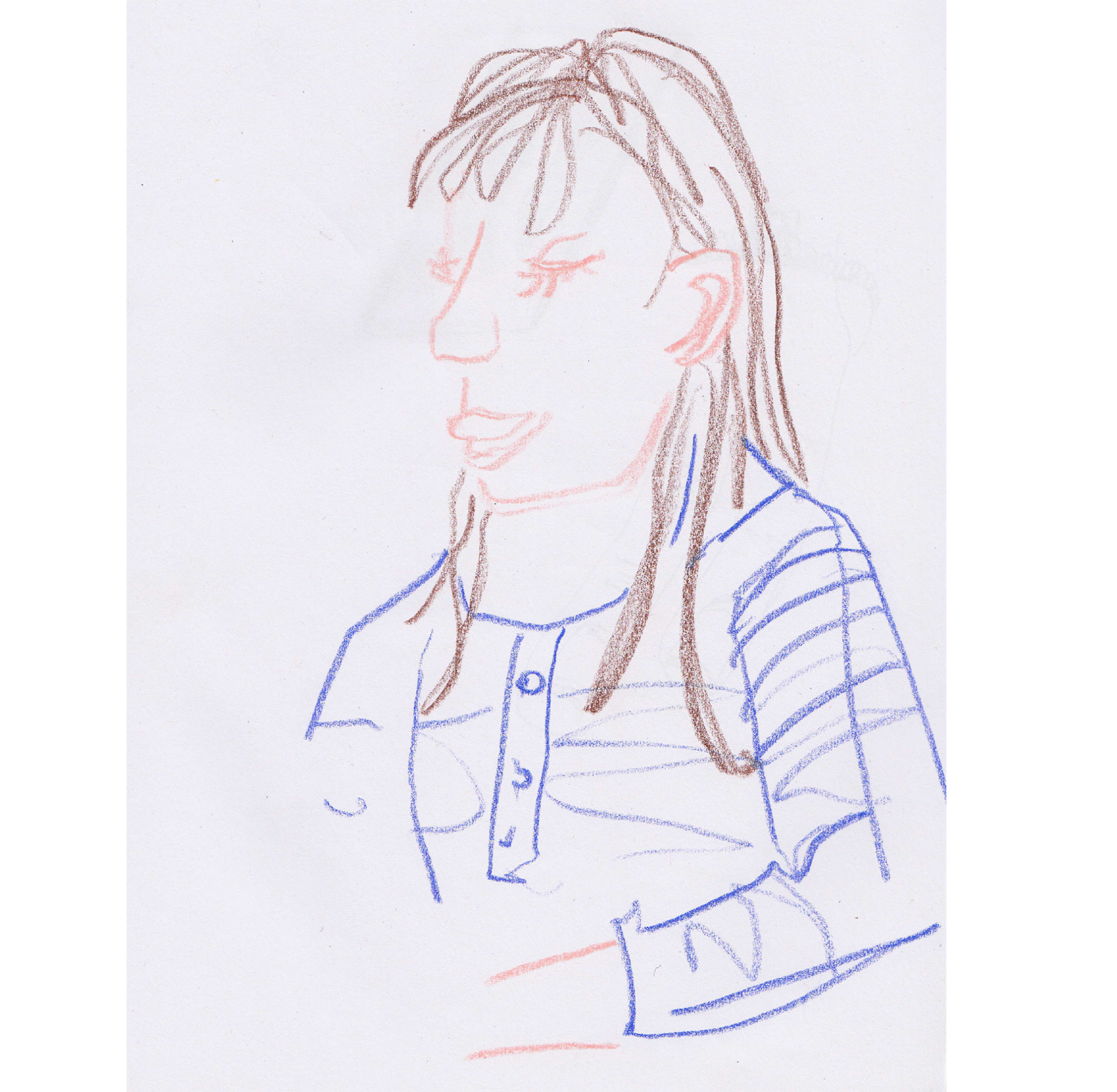
Then we had a minute to draw the person next to us. Peter noted that this is often an 'awkward and embarrassing' exercise, as you don't generally get things quite right, and are afraid of offending your subject! Here is my drawing of Katie, who was sitting to my right. I found it was actually quite good to be under pressure to simply draw a person in this way. It reminds me of when I used to sketch people covertly on the bus...although sometimes they'd realise and get a bit creeped out! It's a good way to forget about the 'technicalities' of drawing, and rather draw to simply try and capture the essence or spirit of a person/thing. So although this isn't an amazing portrait, I hope I captured some of Katie's stillness and concentration- as she was also busy trying to draw the person next to her!

Next up, I sketched my journey to college. This immediately turned into a diagrammatic form, and I found I was pretty much just drawing my thinking process of each step of the way 'Oooh, it's time to go, out the door, down the corridor, press for the lift, out the main door, walk down the road to the tube station, onto the tube, off at pimlico, up those long escalators, walk the rest to college'. 
I enjoyed this sketch, because it was all about process, moving from one thing to another, as a way of explaining the whole. 
 After this, we had to draw a series of sounds that Pete played to us. I loved how instinctive this was. I'd brought along coloured pencils, and found myself being drawn to different colours as a way to 'record' each sound. 

-traffic - I used brown, on reflection, perhaps to convey a sense of pollution/fumes? The lines squiggled like the car engines revving.

 purple- a cat meowing. the noise seemed to come in cycles, which led me to drawing swirls
brown- a dog barking. It sounded violent and punchy, so I translated the bark as jagged lines.
red-a car skidding. There was a sense of loss of control with the screeching and skidding sounds, so red for danger seemed appropriate, and I let the pencil marks curve around to follow the sound of the wheels trying to get grip.
 black- footsteps. I made a dot for each step. The smaller dots represent half steps, and the spacing of the dots shows the speed between them.
grey- a whispy line to represent a haunting wind sound
blue- this was the sound of glass smashing. I made a mark with each tinkling noise, trying to evoke the sharpness and shattering.  
finally-
plum- a spooky musical tuned sound- each time the note went up/down, I moved the pencil accordingly
bronze- a bell chiming. I made a mark with each chime, which became squiggly at the end when it reverberated. 

So mostly, 'sketching' sounds was an exercise in mark-making. Our tutor then said it would be interesting to hand these marks to a musician and ask them to 'play' them back. I think this is a great start point for 'innovation' - using sketches to interpret a physical experience, which can then be explored in a huge variety of ways across many areas of practise...these marks could also make a good start point for a dance piece, or perhaps on an emotional level, as a way to connect with feelings.

Finally, we were tasked with sketching the college itself. This was another memory challenge! And you had to try and be aware of space and scale in order to fit everything on the page. Although my sketch just gives quite a basic overview from above, I think I managed to indicate most of the main buildings/features of the college!
 What a fun and varied week! From portraits to diagrams, and from plans to squiggles. I enjoyed playing around and experimenting with sketching with these different intentions. There is just one more drawing I need to upload from this session- but it's on the way!